
From Vision to Reality: Choosing a Custom Home Builder in MD
Why Building a Custom Home in Maryland Starts with the Right Builder

When you build a custom home in maryland, you're not just constructing a house—you're creating a personalized sanctuary that reflects your lifestyle, meets your family's unique needs, and positions you for long-term satisfaction. Here's what you need to know:
Key Steps to Build a Custom Home in Maryland:
- Establish Your Budget - Average costs range from $206,687 total, or $160-$300 per square foot
- Choose Your Lot - Either purchase land or use an "On Your Lot" program in counties like Baltimore, Carroll, Howard, or Harford
- Select a Licensed Builder - Verify credentials, check portfolios, and review past client experiences
- Design Your Home - Work with architects or use design-build services for custom plans
- Secure Financing - Obtain a construction loan or construction-to-permanent mortgage
- Steer Permits - Your builder manages county permits, inspections, and zoning requirements
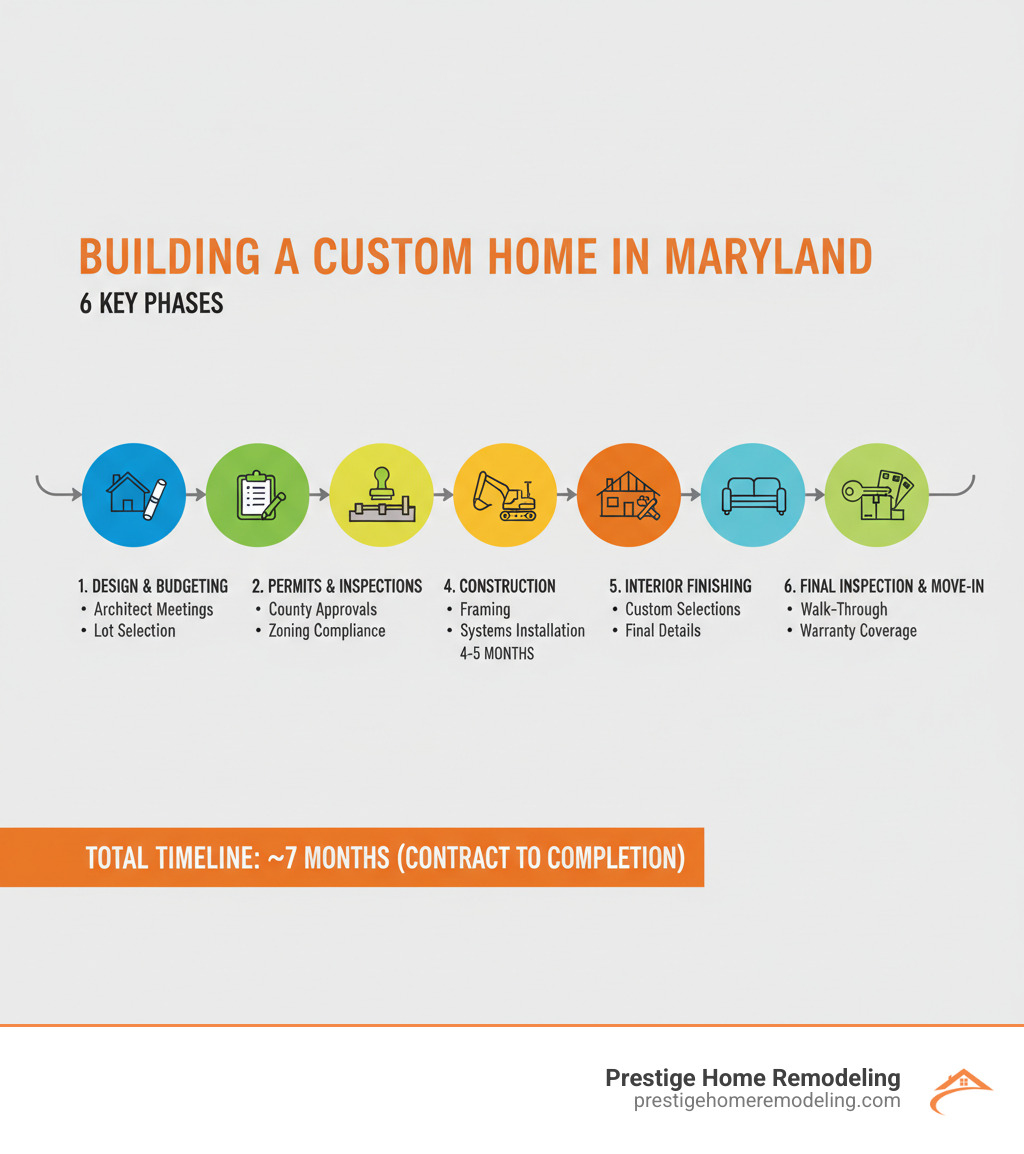
- Monitor Construction - Typical timeline is 7 months from contract to completion
The difference between a stressful building experience and a rewarding one comes down to choosing the right partner. Maryland offers diverse building opportunities—from the rolling hills of Carroll County to the busy suburbs near Baltimore and Washington D.C.—but the process involves complex decisions about location, design, materials, budgeting, and timeline management.
As Michael Aiello, I've successfully designed and built over 1,000 homes throughout the Baltimore, Washington, and Virginia areas over three decades, giving me expertise in what it takes to build a custom home in maryland that exceeds expectations. At Prestige Home Remodeling, we bring 50+ years of combined experience to help you steer every phase of your custom home journey with transparency and craftsmanship.
Understanding the Costs and Financing for Your Maryland Dream Home
Let's talk about money. When you're ready to build a custom home in Maryland, understanding the financial side is just as important as choosing paint colors—maybe more so.
The internet will tell you that the average cost to build a house in Maryland is $206,687. Here's the truth: that number doesn't tell the whole story, especially for custom homes. That figure includes smaller, more basic homes that bring the average down significantly. When you're creating something truly personalized—a home designed specifically for how you live—you're looking at a different picture entirely.
A more realistic way to budget for a custom home is by square footage, which typically ranges from $160 to $300 per square foot in Maryland. So if you're dreaming of a 2,500 square foot home, you're looking at somewhere between $400,000 and $750,000 for construction alone. And yes, that's before purchasing your lot.
Beyond the construction costs, you'll want to think about your overall financial picture. Financial experts typically recommend keeping your total housing payment—that's mortgage principal, interest, property taxes, insurance, and any HOA dues—at around 28% to 30% of your gross monthly income. This ensures you can comfortably enjoy your new home without financial stress.
Maryland's property taxes average 1.06% of your home's value, though some counties see median annual bills reaching $5,582 due to higher property values. The good news? Maryland homeowner's insurance is surprisingly affordable, averaging just $1,518 per year for a $300,000 home—that's 34% below the national average.
For a deeper look at managing your finances throughout the building process, check out our guide on Financing Options for Maryland Home Remodel and browse our Category: Financing resources.
Key Factors That Influence the Cost to Build a Custom Home in Maryland
Every custom home is different, and several key factors will shape your final investment.
Location matters more than you might think. Land costs vary dramatically across Maryland. Building near Baltimore, in Howard County, or in sought-after parts of Anne Arundel County will cost more than rural areas. Even within the same county, you'll see significant price differences between suburban and rural settings.
Home size is straightforward—more square footage means more materials and more labor. A 1,800 square foot home will cost considerably less than a 3,500 square foot home, even with similar finishes.
Architectural complexity can really move the needle on costs. A simple, rectangular floor plan with a standard roof costs less to build than a home with multiple angles, custom rooflines, vaulted ceilings, or intricate architectural details. Beautiful, unique design often requires specialized skills and more time to execute properly.
Material quality is where your personal choices shine through—and where budgets can flex significantly. About 50% of your construction cost goes toward materials. Choosing high-end natural stone countertops, custom cabinetry, premium hardwood flooring, or energy-efficient windows will increase costs compared to standard-grade options. But these choices also define how your home looks and feels every single day.
Labor costs typically account for 30% to 40% of your total budget. Maryland's labor costs are actually more favorable than many states, but skilled craftsmen who can execute custom features properly are worth their weight in gold.
Site work is the factor that catches most people off guard. If your lot needs extensive grading, tree removal, rock blasting, or installation of a well and septic system, you could easily add $20,000 to $50,000 or more to your budget. We always recommend a thorough site evaluation before finalizing your budget.
Securing a Construction Loan
Financing a custom build works differently than buying an existing home. You can't just get a traditional mortgage and hand over a check—construction happens in stages, and your financing needs to match that reality.
Most people use a construction-to-permanent loan, which starts as a short-term construction loan and automatically converts to a regular mortgage once your home is complete. This saves you the hassle and expense of closing on two separate loans.
Here's how the process typically works: Your lender will review your financial stability, examine your builder's credentials and financial health, and carefully scrutinize your detailed construction plans and budget. Once everything is approved, funds are released in stages called "draws"—after the foundation is poured, when framing is complete, once the roof is on, and so forth. An inspector verifies that each phase is complete before the next draw is released.
Working with lenders who understand custom construction makes this process much smoother. They know what to expect, what questions to ask, and how to keep things moving forward without unnecessary delays.
At Prestige Home Remodeling, we've guided hundreds of clients through this process and can help you understand what to expect financially at each stage. For more insights on financing your build, explore our article on build a home.
The Step-by-Step Process to Build a Custom Home in Maryland
When you decide to build a custom home in maryland, you're starting on an adventure that transforms raw land into your dream sanctuary. Understanding what lies ahead makes the journey less intimidating and far more enjoyable. While you might hear that homes in Maryland take about seven months from contract to completion, the reality for truly custom homes often involves a bit more time. After all, creating something uniquely yours—with intricate designs, hand-selected materials, and specialized craftsmanship—naturally takes longer than cookie-cutter construction.
At Prestige Home Remodeling, we break down this seemingly overwhelming process into clear, manageable phases. From your first sketch on a napkin to the moment you turn the key in your front door, we're with you every step of the way. Our approach emphasizes transparency—no surprises, no confusion, just steady progress toward your vision. If you're looking for a straightforward overview of what to expect, we recommend checking out this easy-to-read guide that walks through the building process in simple terms.
The journey typically unfolds through several key phases: design and planning, permitting, site preparation, construction, interior finishing, and final inspections. Each phase builds on the previous one, creating momentum toward your finished home. Let's walk through the critical early stages that set the foundation for everything that follows.
Phase 1: Design, Budgeting, and Lot Selection
This is where dreams start becoming blueprints. It's honestly the most exciting phase for many homeowners because you're making all those big decisions that will define your home's character.
Hiring a designer or architect is your first major step. You have options here. Some clients prefer working directly with an independent architect to create a completely one-of-a-kind design from scratch. Others choose design-build services, where the same team handles both design and construction. The design-build approach offers real advantages—better communication, fewer hand-offs, and one point of accountability from start to finish. We work closely with you during this phase, refining your ideas and ensuring the design fits your lifestyle, budget, and the unique characteristics of your lot. Organizations like the American Institute of Building Design can connect you with qualified design professionals if you're exploring your options.
Finalizing floor plans involves creating detailed architectural drawings that capture every aspect of your home. We're talking about floor plans, elevations, structural details, and specifications for everything from ceiling heights to window sizes. This isn't just about aesthetics—these drawings become the roadmap for construction and the basis for your building permit applications.
Selecting a lot deserves careful thought if you don't already own land. Your lot influences everything—how your home sits on the property, which direction it faces, how much site work you'll need, and ultimately what it costs to build. A sunny southern exposure might reduce heating costs. A sloped lot might require additional foundation work but offer stunning views. We provide site evaluation services to help you understand what you're working with before you commit. We'll identify potential challenges like drainage issues, soil conditions, or utility access, as well as opportunities to optimize your home's placement and design.
Phase 2: Permits and Inspections
Here's where things get a bit technical, but don't worry—this is exactly where an experienced builder earns their keep. Maryland's county requirements for building permits, zoning compliance, and inspections can feel like navigating a maze. Each county has its own rules, timelines, and processes.
We handle the permit applications on your behalf, submitting detailed plans to the local permitting office for review. For example, if you're building in Carroll County, there are specific steps outlined by Carroll County Government for new home construction. Baltimore County has its own requirements, which you can learn more about in our article on Permits for Home Renovations in Baltimore County.
Building permits must be secured before any construction begins. This involves submitting your architectural plans for review to ensure they meet current building codes and safety standards. Zoning laws dictate how your property can be used—including setback requirements (how far the house must sit from property lines), height restrictions, and sometimes even architectural style guidelines in certain communities.
Throughout construction, required inspections occur at critical milestones. County inspectors verify that work meets code at various stages—foundation, framing, plumbing rough-in, electrical rough-in, insulation, and final completion. We schedule and coordinate all these inspections, ensuring they happen promptly so your project maintains momentum. Most homeowners never need to think about this process because we manage it entirely, keeping your build on track and fully compliant with local regulations.
Custom Home vs. Standard Home: What's the Right Choice in Maryland?
When starting on the journey to a new home in Maryland, you'll encounter two primary paths: building a custom home or choosing a standard (often called "production") home. While both result in a new residence, the experience, flexibility, and outcome are vastly different.
The key distinction lies in the level of personalization and control you have. A custom home is a unique creation, designed specifically for you and your chosen lot. A standard home, conversely, is built by a developer in a planned community, usually from a limited selection of pre-designed floor plans.